

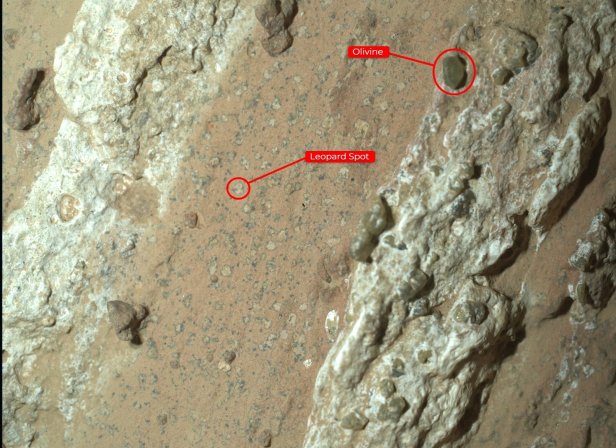
NASA’s Mars rover has recently made an important discovery that has increased the possibility of possible evidence of life on Mars. This discovery has created a new wave of excitement and curiosity in the scientific community. NASA’s Perseverance rover has discovered some evidence on the surface of Mars that may point to the possibility of life there at some point.
The importance of these discoveries also increases because Jezero Crater is believed to be an ancient lake basin, where evidence of the presence of water has already been found. Water is an essential component for life, and combined with the presence of organic molecules, it proves that there were once suitable conditions for life on Mars.

NASA’s Perseverance rover has analyzed a specific type of rock in Jezero Crater, which has found possible evidence of ancient microorganisms. Some organic molecules have been found in these rocks that indicate the existence of life. These molecules are organic compounds, which are essential for life and increase the possibility that there could have been life on Mars at some point.

The main purpose of the Perseverance rover, which was launched in 2020, is to investigate the surface of Mars and find signs of possible life. The rover is equipped with several state-of-the-art instruments that are capable of analyzing samples of rocks and soil!
The Perseverance rover has a special instrument called SHERLOC (Scanning Habitable Environments with Raman & Luminescence for Organics & Chemicals). This instrument has identified organic molecules in the rocks. Apart from this, the rover has also found signs of the former existence of water on the surface of Mars, which further strengthens the possibility of life. Scientists now plan to bring these samples back to Earth to study them in more depth. This discovery is an important step in the search for life on Mars and opens up new directions for future missions.

