

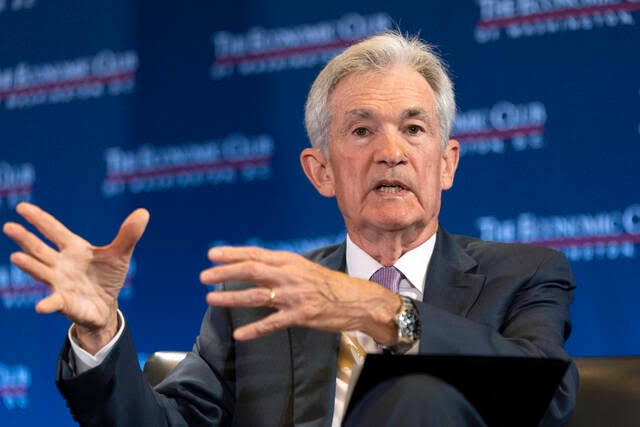
America’s top central banker has clearly signaled that interest rate cuts are finally coming, a key milestone for the Federal Reserve’s historic and so far successful fight against inflation. “It’s time to adjust the policy,” Fed Chairman Jerome Powell said in remarks prepared for his keynote speech at the annual gathering of central bankers and economists in Jackson Hole, Wyoming. “We will do everything possible to support a strong labor market while making more progress towards price stability,” he said.
The Fed chief also expressed confidence in the ability of the U.S. economy to achieve a “soft landing,” a very rare consequence in which inflation is contained without the rapid rise in unemployment. Such a feat was achieved only once, in the mid-1990s.
Powell said, “With the appropriate easing of policy restrictions, there is a good chance that the economy will return to the target of 2% inflation as well as maintain a strong labor market.” Markets reacted positively to his statement, and all three major indices moved higher on Friday.
“Powell has sounded the bell for the start of the cut cycle,” Seema Shah, chief global strategist at prime asset management, said in a note on Friday.
The Fed’s aggressive interest rate hike campaign, which began in early 2022, took interest rates to a 23-year high, aimed at fighting the highest inflation in decades. The Fed’s benchmark lending rate, which affects borrowing costs in the economy, has remained at its current level for the past year. From mortgage rates to credit cards, everyday consumers and businesses are being affected by tougher borrowing costs. But the aggressive action of the central bank is showing an effect. Inflation has come down well below a 40-year high two years ago and despite a modest rise in unemployment in recent months, the job market is in overall good shape. And so has the broader U.S. economy: economic growth has been solid this year and the Atlanta Fed estimates that growth has not fallen. Fed is indeed working in the right direction for a soft landing. Powell’s latest statements open up the possibility of a first-ever interest rate cut at the Fed’s policy meeting on September 17-18. Americans have already felt some relief, which comes from falling bond yields, which move forward in anticipation of the Fed’s interest rate decisions. Mortgage rates, which follow 10-year U.S. Treasury yields, fell earlier this month.
“Tom Porcelli, chief U.S. economist at PGIM Fixed Income, told CNN, “”Things will remain stable.” The labor market is cooling, but it’s not softening. Household balance sheets are solid overall, especially in the higher income bracket, which accounts for a large portion of overall spending.”
An important turning point
The Fed’s decision to cut the interest rate is a sign that officials are “confincing” that price pressures are coming under control. The slowing job market is also prompting the Fed to reduce borrowing costs. The Fed’s preferred inflation gauge — the personal consumption expenditure price index — stood at an annual rate of 2.5% in June, up from 7.1% two years ago. Powell, in his speech, attributed this progress to a “reversal” of pandemic-related supply and demand distortions, which exacerbated inflation around the world following the COVID-19 pandemic.
Inflation fell in the second half of last year as the broader U.S. economy remained strong. Much of this can be attributed to supply-side reforms, such as the larger workforce and the healing supply chain. The U.S. economy also experienced improvements in productivity growth, which strengthened growth without fueling inflation. The return of the job market to normal has also been helpful in reducing the pressure on prices to some extent.
Powell said, “Our restrictive monetary policy contributed to the reduction in overall demand, which, along with improved supply, helped ease inflationary pressures, while continuing growth at a healthy pace. Along with the decline in labor demand, vacancies historically higher than unemployment were generalized primarily through reductions in vacancies, without large-scale and disruptive layoffs, which put the labor market in a position where it is no longer the source of inflationary pressures.”
Job openings, which represent employers to demand workers, stood at 8.2 million in June, well below the record high of 12.2 million in March 2022. The salary increase has also cooled considerably in the last few years.
 95TechGuru